


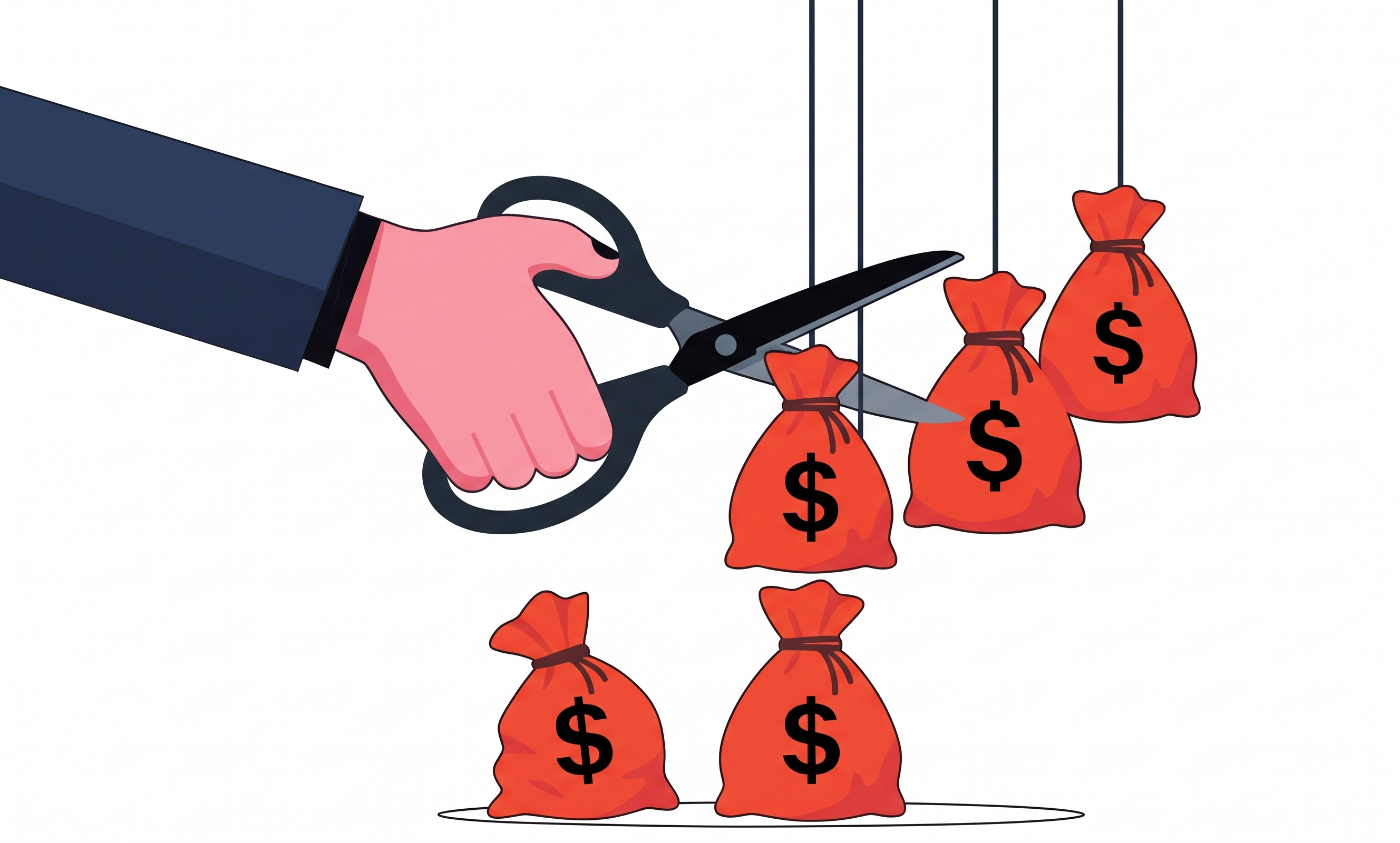
President Trump announced his second round of “pocket rescissions” last Friday, cutting $810 million in spending on programs that his administration has categorized as wasteful, ideological or not in the national interest.
Those include DEI-related spending, aid to illegal immigrants and more across several major Cabinet departments. For regular readers of Open the Books, they will look similar to programs our auditors have flagged for scrutiny in the past.
What are Pocket Rescissions?
Rescission, in the context of government, is the cancellation of funding already appropriated by Congress.
President Trump used the process to push a $9 billion package of rescissions in 2025, which included cancellation of funds appropriated for the Corporation for Public Broadcasting (CPB) and foreign aid. CPB (the organization that distributed funds to PBS and NPR affiliates) saw its current funding cancelled along with the rescinding of hundreds of millions of dollars in future funding. Combined, the rescission and cuts were $1 billion and eliminated CPB funding. As a result, the organization voted to dissolve itself as of January 2026.
The remaining roughly $8 billion in rescissions went to foreign aid and international development programming. It included the Economic Support Fund, the Democracy Fund, the Inter-America Fund, “migration and refugee assistance,” the Contributions to Clean Technology Fund and USAID operating expenses.
Congress approved this package in July 2025.
“Pocket recission” starts the same way: asking Congress to cancel funds. There is a 45-day “withholding period” during which the president can keep appropriated funds from being obligated for spending, the same amount of time that Congress has to consider the President’s proposal.
But when the fiscal year ends sooner than 45 calendar days, the funds will remain withheld until they expire or before Congress can respond. Trump has found this authority in the Impoundment Control Act.
Because Congress has gaveled out and lawmakers have returned home to campaign, it is highly unlikely that President Trump will get a response, leaving the funds to expire during their withholding period.
Last year, after Congress approved the $9 billion formal rescission, Trump embarked on his first pocket rescission: another $4.9 billion in cancelled foreign aid and funding for international organizations.
On August 29, 2025, the White House referred to it as a “historic” cancellation of “woke, wasteful and weaponized spending.”
“Now, for the first time in 50 years, the President is using his authority under the Impoundment Control Act to deploy a pocket rescission, cancelling $5 billion in foreign aid and international organization funding that violates the President’s America First priorities,” according to a press release.
The rescission included $3.2 billion in development assistance through USAID. Part of that money was $400 million for “green” initiatives like a partnership with the Green Climate Fund, $39 million for “biodiversity and low-emissions development in West Africa,” and $25 million to build “climate resilience” in Honduras.
Cancelled funds for international organizations included $45 million to the Pan American Health Organization (PAHO), a “regional arm of the World Health Organization”; $75 million for United Nations Educational, Scientific and Cultural Organization (UNESCO); and “budget support for countless organizations like the Colombo Plan Council for Technical Cooperation, the International Tropical Timber Organization, and the Pan American Institute on Geography and History.”
Cancelled funds for international peacekeeping amounted to $838 million. That included “nearly $300 million annually to Somalia for peacekeeping and UN programs that have manifestly failed to stop piracy or provide lasting peace and security.”
Legal Debate: Power of the Purse
Critics have attacked this move as a short-circuiting of Congress’ authority to appropriate funds.
The Government Accountability Office (GAO) stated in August 2025 that it did not believe the Impoundment Control Act allows the president to do this:
“A pocket rescission could allow a president to avoid spending the money regardless of whether Congress approves the rescission request. This would cede Congress’s power of the purse by allowing a president to, in effect, change the law by shortening the period of availability for fixed-period funds…. We found that there is no basis to interpret the ICA as a mechanism by which a president may shorten the time period that an appropriation may be used.”
But GAO also conceded that pocket recission is not a new invention of Trump’s. President Jimmy Carter used it on a smaller scale in 1977. Per the Congressional Research Service, Carter sent Congress “a special message asking that $21 million in appropriations for Foreign Military Credit (FMC) sales be rescinded. Thereafter, Congress adjourned for roughly a month, from early August to early September. The FMC sales appropriation expired on September 30. GAO observed that the funds lapsed “before the end of the [ICA’s] 45-day period.”
Prior to that, President Nixon had impounded tens of billions in funding appropriated by Congress. He’d “impounded” the funds. That was the move that led Congress to pass the Impoundment Control Act in the first place and create the 45-day rescission process that keeps Congress in its approval role.
Nixon’s push for unilateral cancellation of spending never made it to the Supreme Court after the ICA was enacted. Although Train v. New York saw a narrower ruling on EPA funds, the broader Constitutional question about executive authority to impound funds still lingers, especially where statute allows for agency input.
As the Tax Policy Institute contends:
“The Constitution is clear that a president cannot spend money without a Congressional appropriation. It is less clear whether a president must spend money that has been appropriated by the Congress.”
This week, the Office of Management and Budget characterized pocket rescission as “a neglected authority provided to him under the Impoundment Control Act.”
OMB said the second pocket rescission is “a continuation of the Trump Administration’s promise to the American people to utilize all possible tools to stop government spending that does not benefit American citizens.”
Congressional appropriators like Sen. Susan Collins (R-ME) tend to disagree. Collins said OMB was attempting to “undermine Congress's Constitutional power of the purse.”
What Did the President Cancel This Week?
The $810 million of pocket rescissions are sweeping, including spending across several major Cabinet agencies. As President Trump wrote to Speaker Mike Johnson, they “affect programs of the Departments of Commerce, Education, Health and Human Services, Homeland Security, Housing and Urban Development, and Justice, as well as…International Assistance Programs.” Here’s a sampling.
HHS: $567 million in “services for noncitizens”
Per the White House, this money “previously went to pro-illegal immigration programs and Non-Governmental Organizations that provided services to refugees, asylees, and other non-citizens and put unaccompanied children in harm’s way.” Because border crossings have been reduced to effectively zero, the administration argues these are excess funds. One example cited was $3.9 million to Endeavors, Inc., an organization led by a former Obama-era DHS employee that offers immigrant kids “pet therapy,” “horticulture therapy,” and music therapy.
NOTE: Last year, Open the Books found over $22 billion had been spent since 2020 on immigrant aid through the Office of Refugee Resettlement, part of HHS subagency the Administration for Children and Families. At the time, we wrote, “ORR has spent over $22.6 BILLION since 2020 on grants to nonprofits providing everything from help accessing Medicaid to help building credit, help with home and auto loans, and cash assistance.” HHS Secretary Robert F. Kennedy followed up several months later, banning access to its programs by illegal immigrants.
Read more at Cash for Migrants.
DHS: $25 million in “welfare” for illegal immigrants and to “aid and abet” entry
This funding is described as grants to nonprofits that were offering legal aid and other help with “affordable housing, childcare, transportation, healthcare, schooling, language classes, and orientation.”
The funding includes grants to nonprofits like $300,000 to the Immigration Institute of the Bay Area, the “largest nonprofit provider of immigration legal services in Northern California.” Open the Books previously flagged more than $7 million worth of funding for this organization from the feds and the state of California, specifically highlighting the DHS grant.
At the time, we wrote:
Immigration Institute of the Bay Area (IIBA) provides similar legal services as the other organizations on this list, which includes applications for naturalization, citizenship, family reunification, and DACA (Deferred Action for Childhood Arrivals) renewal.
While IIBA does not appear to be as involved in policy advocacy as others on this list, the nonprofit also sponsors, and co-launched, the San Francisco Public Defender’s Office’s Immigration Defense Fund, which provides services to those facing deportation.
Spending by California State Agency (per Open the Books checkbook data):
2023:
Department of Education……………….$19,255.00
Department of Social Services………..$2,716,376.812024:
Department of Education………………..$35,467.00
Department of Social Services…………$4,336,027.27The federal government’s Department of Homeland Security granted IIBA $300,000 in 2024 for “citizenship instruction, naturalization application services, and immigration integration in the greater San Francisco Bay area” which appears to still be active.
That article highlighted other California NGO’s that were receiving state funding while also working to impede ICE enforcement efforts. This latest Trump pocket rescission addresses that in Massachusetts, too. It cancels another $300,000 to Massachusetts Immigrant and Refugee Advocacy Coalition, “which provides a ‘youth toolkit’ with instructions to call the ICE Watch Hotline if you see ICE in your neighborhood.”
Department of Education: $25 million in programming for non-citizens
This funding category, per the White House, includes grants for nonprofits like “Immigrants Rising,” which runs support groups like “We Glimmer” for LGBTQ+ immigrants, “Therapy for Latinx,” and mental health for “Coping with DACA-Related Stress,” a program that “encouraged aliens to avoid encounters with law enforcement.”
HHS Office of Minority Health: $5 million in sex- and race-based funding
This category includes $1.2 million to study “Intersectional Mental Health Disparities Among Youth” described as “disproportionately Black, Latino, and [with] limited-English proficiency.” Another $2.1 million is for a fellowship at George Washington University to “advance health equity as well as diversity, equity, and inclusion in needed spaces, such as the federal government.”
NOTE: Open the Books did an extensive audit of the Department of Health and Human Services and found that both the Cabinet-level agency and various subagencies like Centers for Disease Control (CDC) have offices focused specifically on minority health. We wrote:
“Their mission is to ‘improve the health of racial and ethnic minority populations through the development of health policies and programs that will help eliminate health disparities.’
“[We] identified 207 employees making $29.4 million. Again, the vast majority of them — 182 — make six-figure salaries.
“These programs have existed since 1985, but the Biden administration has now encouraged them to champion health equity: “the state in which everyone has a fair and just opportunity to attain their highest level of health” by “addressing historical and contemporary injustices.”
…
One recent CDC program pushed for “vaccine equity” in Atlanta, Georgia by distributing 5,500 monkeypox vaccine doses to Black “LGBTQ+ men who have sex with men” to help “celebrate diversity and the impact of distinctly Black gay and queer culture on the community.”
The CDC has even deployed to Black churches in the name of “vaccine equity.” The agency “trained” 4,300 faith leaders as “vaccine advocates and influencers” who could convince their congregations to get vaccinated — and give out “incentives” for doing so. The program included 1200 church vaccination sites and distributed 650,000 doses while issuing public service announcements aimed at reducing “vaccine hesitancy” and “debunking myths.”
Records of both vaccine equity programs have been removed from the CDC’s website. [Read more here].
These and other rescissions part of the new $810 million announcement can be found at WhiteHouse.gov.
[Click here to download the full request to Congress]
Savings in Perspective
While many taxpayers may agree these spending programs are wasteful or don’t advance the public good, it’s important to keep in mind the scale and scope of these rescissions at less than $1 billion.
Last September, as part of the federal government’s wasteful “use-it-or-lose-it” spending habits, the Pentagon spent over $50 billion in the final week of the month.
That single week in a single Cabinet department surpasses not just these rescissions, but the prior pocket rescissions and the formal rescissions package. Combined, they cancelled just under $15 billion in appropriated spending.
Looking ahead, Congress is once again asking for tens of billions of federal tax dollars to be spent on their earmarks, local pet projects they want to fund. Some of those requests will inevitably include the kind of ideologically-driven spending this rescission aims to eliminate.
And discretionary spending is just a tiny piece of the overall spending and debt picture.
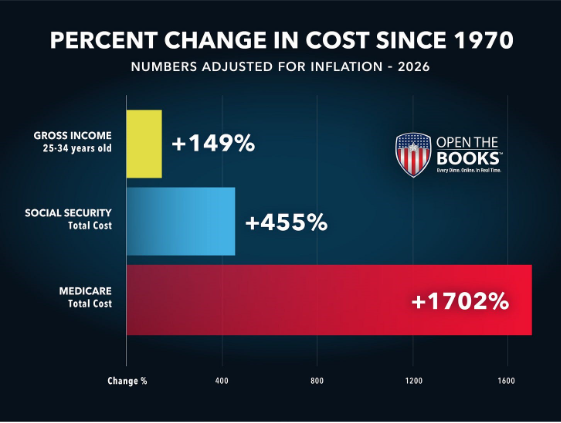
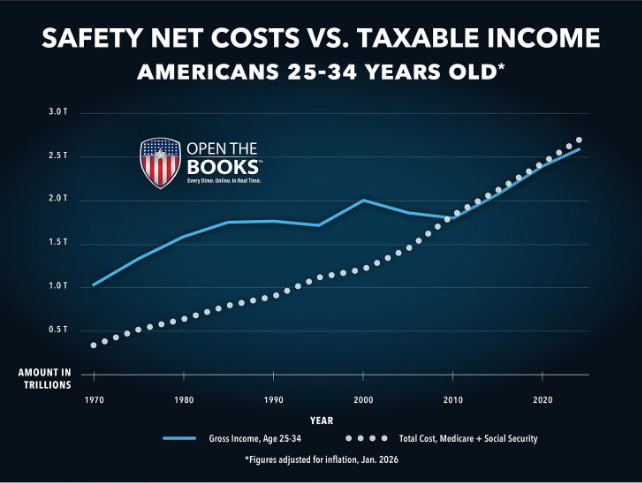
Open the Books recently reported that the cost of our safety net programs have outstripped all taxable income earned by Americans aged 25-34. A whole generation is going to work every day and even confiscating 100 percent of their earnings would not cover Medicare, Medicaid and Social Security.
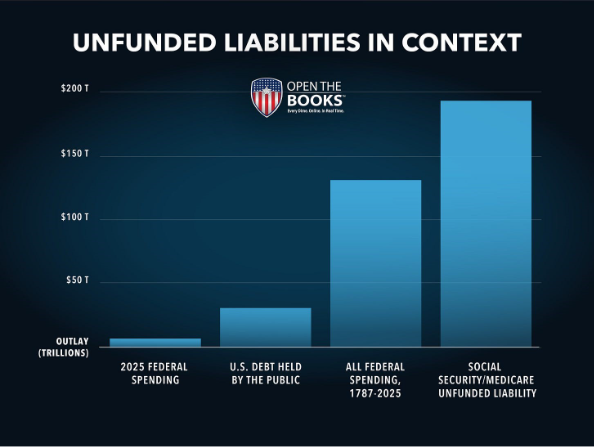
The annual Treasury Department report on the fiscal position of the United States predicts what our current spending promises will cost Americans as their children and grandchildren access safety net programs. Their most recent calculation for that “infinite horizon” is that the programs are underfunded by $193.6 trillion.
Durable savings can only come from responsible budgets for discretionary spending coupled with major reform to mandatory spending programs.
The question before our Wastrel Congress should ALWAYS be "Is this expenditure worth going further in debt?" The people that create wasteful spending should be exposed to the public at voting time.
A responsible Congress would estimate the annual tax revenue and divide each "Must have" expenditure into it. "Nice to have" spending should come from any unexpected overages. Every "Mandated" expenditure should be evaluated annually. Fiscal sanity.
TY President Trump. You served up one positively DELICIOUS breakfast this morning. The diners at the NPR Take-Out were not happy, let me tell you...
And you really put the pinch on those Eateries who use the very popular order-and-deliver straight-to-your door app that is used so extensively in other counties.
Sir, you are one hell of a Cook.