


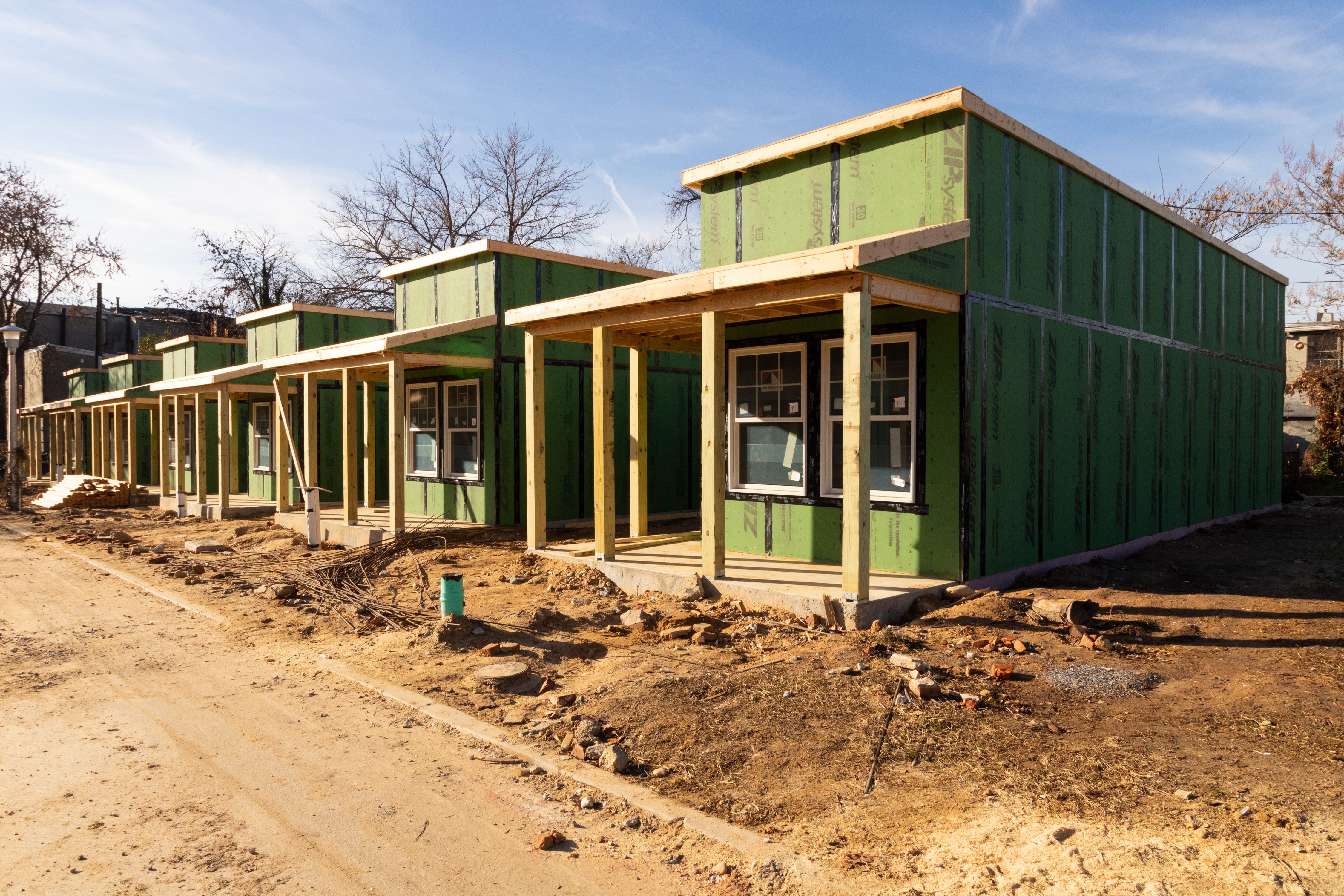
This case study on California demonstrates the government hurdles to constructing quality, affordable homes. It’s a part of our major housing report, covering affordability across all 50 states. Click here for the full report.
One way to gauge affordability is to track how far home prices have outpaced incomes over time. By that measure, California’s story looks almost reassuring. Between 2015 and 2024, the gap between the state’s home price index growth (82.5%) and its income growth (55.3%) was about 27 percentage points, ranking relatively low at 42nd out of the 50 states. This is nowhere near the 70+ percentage point gaps recorded in states like Idaho or Florida.
However, that modest gap doesn't reflect an affordability success story. Instead, it reflects a state that was already an exceedingly expensive place to buy a home. California entered 2015 with some of the highest housing costs in the nation. The typical home was valued at $522,000 according to data from the Federal Housing Finance Agency. A decade later in 2024, the median home price was still in the top ten at $953,000. The state's incomes weren't stagnant; they were simply racing to keep pace with a price level that kept growing.
According to the U.S. Department of Housing and Urban Development's point-in-time count, 187,084 people were without a home in January 2024. That's the most the state has ever recorded, up from 118,142 in 2016.
The state estimates it needs about 180,000 new homes a year, yet production ran below 100,000 for most of the 2010s, and only 47% of identified regional need was built between 2003 and 2014.
Housing has become one of the defining political liabilities of Gavin Newsom's governorship. He took office in 2019 promising 3.5 million new homes by 2025, a target the state has fallen drastically short of, with fewer than half a million units completed between 2019 and 2023. That gap has put Newsom under pressure from his own party's pro-development wing, whose members have pushed him to override local zoning fights and speed up approvals. Newsom has responded in kind, at points threatening to force housing measures through the state budget process when legislative negotiations stalled. This year, he backed an $11.25 billion bond measure headed to the November 2026 ballot. It is aimed, in part, at funding tens of thousands of already-approved but still-unbuilt affordable units.
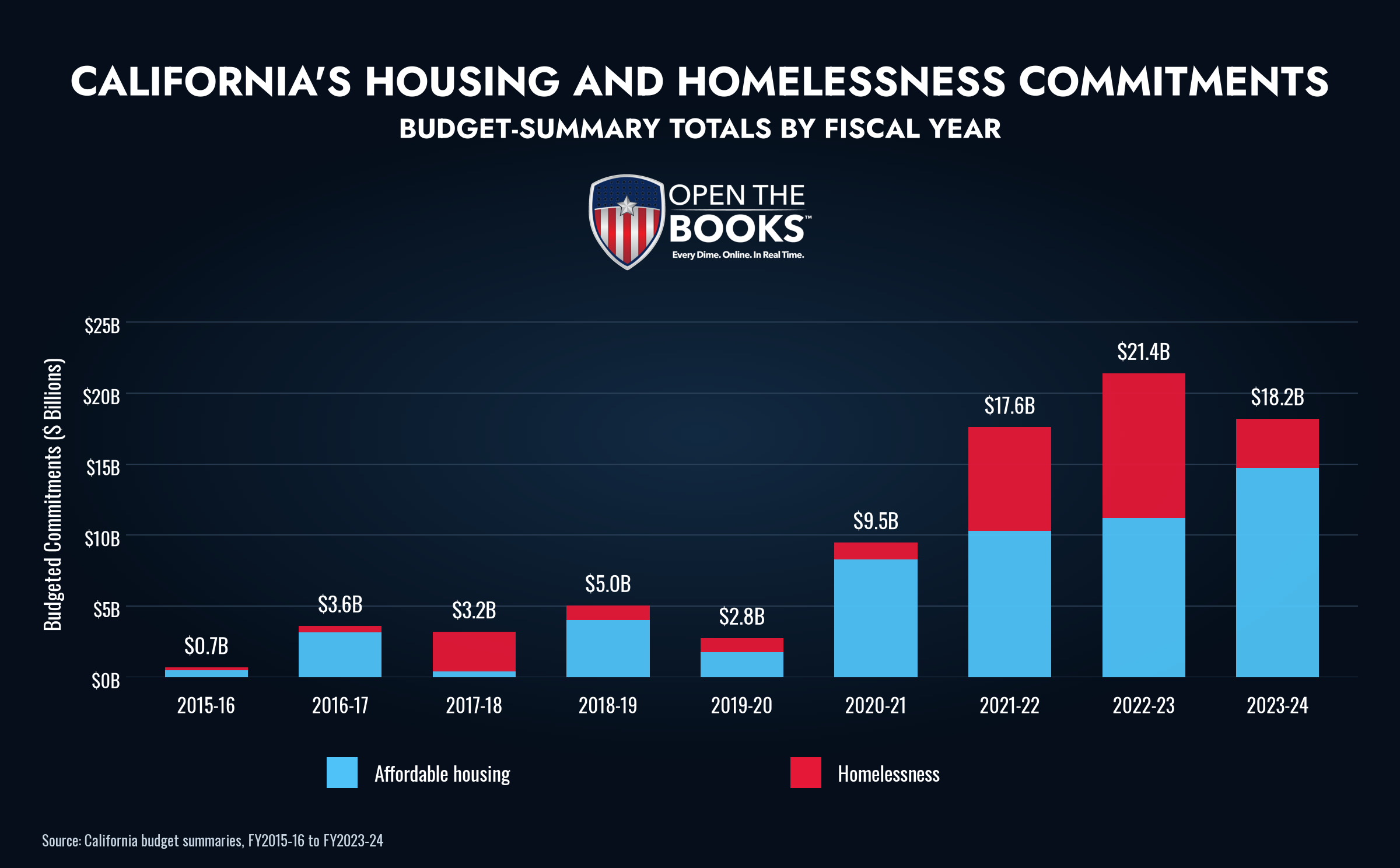
However, the issue is not simply a lack of funding. On the contrary, the Legislative Analyst's Office reported that California directed close to $24 billion to housing and homelessness across the five fiscal years ending in 2023. So, clearly, a great deal of money has been committed on paper. What then is the cause of this disconnect?
What the Totals Represent
What the state does spend is shaped in ways that complicate the picture. A review of California's affordable housing budget tables from 2017-18 through 2023-24 finds that between 62-92% of each year's reported "affordable housing" total is lending that gets repaid or tax credits, rather than grants the state pays out.
By the California Housing Partnership's accounting, support also splits by tenure. In fiscal year 2025-26, the state directed about $6.30 billion toward homeowners, mostly through the mortgage interest and property tax deductions, and about $2.68 billion toward renters. Alongside that, 97% of the homeowner support was permanent, against only 20% of the renter support.
These distinctions matter for anyone reading the topline figure. When the state reports billions "spent" on affordable housing, most of the money it expects back or is tax credit revenue never collected. So, the reported total does not by itself show how much nonrepayable state funding was distributed in a particular year. The permanent, guaranteed help also flows disproportionately to people who already own a home, while renters get a smaller share that mostly expires. In other words, the state's accounting quietly favors the housed over the housing-insecure and presents a headline number that flatters the effort.
Moreover, how much of this is valuable remains, in part, unknown. In 2024, the State Auditor reviewed five homelessness programs that had received a combined $13.7 billion and could identify only two as likely cost-effective, and the agency responsible for tracking results had not analyzed spending since 2021.
None of this means the money is imaginary. Building in California remains slow and expensive, and even the real, buildable dollars struggle to become homes.
The Cost of Building
California's budget analysis has long pointed to local decisions as a driver of both cost and undersupply. One chapter of the state budget summary is titled, plainly, "Local Decisions Drive Per-Unit Costs."
In California's incorporated areas, approximately 82% of residential land is set aside for single-family homes only, indicating that part of the constraint is written in zoning laws. The other part lies in development's raw and steep cost. Affordable projects in California run at a cost that is 2-4x what comparable undertakings cost in Colorado or Texas, with restrictive zoning, slow permitting, and impact fees repeatedly named as drivers. The state pegged the average new affordable unit at about $332,000 as far back as 2017, and the State Auditor later put new construction at $380,000 to $570,000 a unit.
Deputy Policy Editor Rachel O’Brien discusses California’s achingly slow progress on The National Desk:
The Newer Bottleneck
For affordable housing specifically, though, the picture has shifted. Over the past decade the state has passed laws overriding many local approval barriers for affordable projects, and a 2025 federal tax change expanded the Low-Income Housing Tax Credit. The older constraints of slow and expensive building remain, but now the main choke point has since moved downstream, from getting permission to build to getting the last dollars a project needs to start.
The result is a queue of housing that is approved but unbuilt. A 2026 analysis counted about 39,880 affordable units, across 461 fully designed and permitted developments, waiting on their final layer of funding, with an estimated $4.1 billion needed to clear the backlog. The 2018 bond that supplied the last major infusion has been spent, and the governor's budget proposed no new discretionary funding beyond that. As CalMatters reports:
“California's last major infusion of public affordable housing dollars came in the form of a voter-approved bond in 2018. That well has run dry. A hodgepodge of funding streams remain.
“Adding together funding that has already been approved by legislators but not yet spent and a variety of other state and federal sources, California's Housing and Community Development department says at least $1.8 billion should be available for affordable developer applicants this year. Gov. Gavin Newsom's budget proposal for the coming fiscal year doesn't include any new discretionary spending beyond that.”
The way projects assemble that money adds cost of its own. A typical development stacks several public funding sources, each with its own timeline and rules, and each added source was associated with delays of about four months and costs of roughly $20,460 per unit. The California Housing Partnership estimates that consolidating awards into a single funding decision could save about $42,000 per unit.
Taken together, the figures describe a distance between what California appropriates and how many affordable homes get built, shaped by the particular funding source, how projects assemble it, and how much of it is measured.
As of 2026, California has begun implementing a new Housing Development and Finance Committee intended to centralize several affordable-housing programs and eventually provide developers with a common application and more coordinated award process. Whether this step will improve the cost of red tape and remove bottlenecks is a question the next few years will answer.
Government secrecy is not an accident. It’s a strategy. Records disappear. Budgets bloat. Accountability gets buried. Open The Books forces the truth into daylight. But our data journalism is only possible thanks to support from you. Please consider making a gift to help us build on our mission to put every dime online, in real time.
FURTHER READING
Point-in-Time Counts by State, 2007-2024, U.S. Department of Housing and Urban Development
"Housing is dividing California Democrats — so Newsom stepped in," Politico, May 15, 2025
"Gavin Newsom Backs $11.25 Billion Bond Measure To Boost Home Construction in California," Realtor.com, June 2026
California Department of Finance, Governor's and Enacted Budget Summaries from FY2017-18 to FY2023-24 (Housing and Homelessness Chapters)
California Affordable Housing Needs Report 2026, California Housing Partnership
Homelessness in California, Report 2023-102.1, California State Auditor, April 2024
Housing and Local Government , Governor's Budget Summary 2017-18
"Single-Family Zoning in California: A Statewide Analysis", Othering & Belonging Institute, UC Berkeley, April 2024
California has 40,000 affordable housing units ready to break ground. One setback is holding them up, CalMatters, March 9, 2026
2026 California Affordable Housing Production Pipeline, Enterprise Community Partners
Reducing the Complexity in California’s Housing Finance System, Terner Center for Housing Innovation, UC Berkeley
It has always concerned me how realtor fees seem to inflate home values over time. A homeowner is always trying to recoup those fees on the sale of their home.
Canada's housing issues are similarly faulty but for different reasons that makes no sense. Here's a couple of details:
https://heardtheword.substack.com/p/canada-has-a-poverty-of-ideas-about
https://heardtheword.substack.com/p/canadian-poverty-by-the-numbers