



Not since the Bernie Sanders presidential runs five and ten years ago has “Medicare for All” had so much attention on the national stage.
With multiple candidates winning primaries on a platform including this pledge, we gathered some evidence to demonstrate what costs could come with a dramatic scaling of the public health care program.
Splitting a Big Bill
In 2025, Medicare spent $1.2 trillion, or $18,894 per beneficiary.
Multiplied by the 342.85 million U.S. citizens, that would be an annual cost of $6.5 trillion, or an increase of over $5 trillion. That’s likely a significant overestimate - it would cost far less than $18,894 to cover most young people, since seniors require more healthcare.
Previous estimates from George Mason University and the Urban Institute predicted federal spending would increase $3-3.5 trillion under “Medicare for All.” That still brings the total potential spending to more like $4.2 to $4.7 trillion, a staggering figure.
Medicare Already Lacks Funding
Under current policy, Medicare is underfunded by $60.4 trillion over the next 75 years. If Medicare spending were to roughly quadruple, that funding gap would explode to $241.6 trillion without any new tax increases.
Of course, “Medicare for All” would cause health care spending to go down in other areas, as it would replace private health insurance. It’s unclear whether the net result would be more or less healthcare spending, but those dollars spent by households on private coverage would not simply be freed up; they’d need to head to Washington to pay for massive growth to what was considered a safety-net program.
The Congressional Budget Office estimated in 2020 that total healthcare spending could decrease up to $700 billion or increase up to $300 billion per year under Medicare for All, a huge range that demonstrates the uncertainty to come with such a plan.
READ MORE on the CBO’s history of inaccurate, often ideological, scoring of major bills. “Scoring the Scorekeepers” is an Open the Books oversight report released in April 2026.
Improper Payments
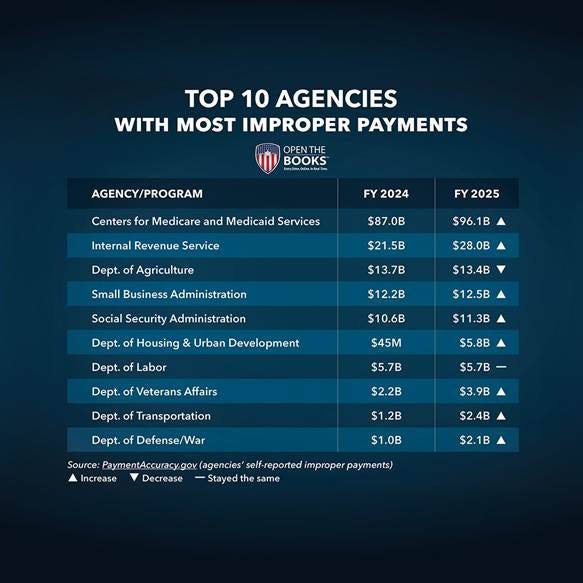
As Open the Books has reported over the years, the Centers for Medicare and Medicaid Services (CMS) routinely tops the list of agencies for improper payments. Those are payments “made by the government to the wrong person, in the wrong amount, or for the wrong reason,” according to federal guidelines.
Improper payments at CMS make up more than half of all improper payments each year. Medicare made $56.7 billion of improper payments in 2025. If Medicare suddenly had quadruple the amount of patients and billing running through the program, that’s an estimated $227 billion of improper payments each year.
A related matter: Medicare also spends $6 billion annually on what’s considered “low-value” care: treatments that the congressional Medicare Payment Advisory Commission recognizes as having no clinical benefit. Again, if we quadruple that figure, we get $24 billion spent on low-value care.
More Context Clues
To get a sense of how much the safety net already costs us -- in terms that are easier to conceive of than the trillions discussed here -- consider that the costs of these programs has already grown bigger than all the taxable income earned by a generation of Americans.
Around 2017, the cost of Medicare and Social Security crept higher than the total gross income of every taxpayer aged 25-34.
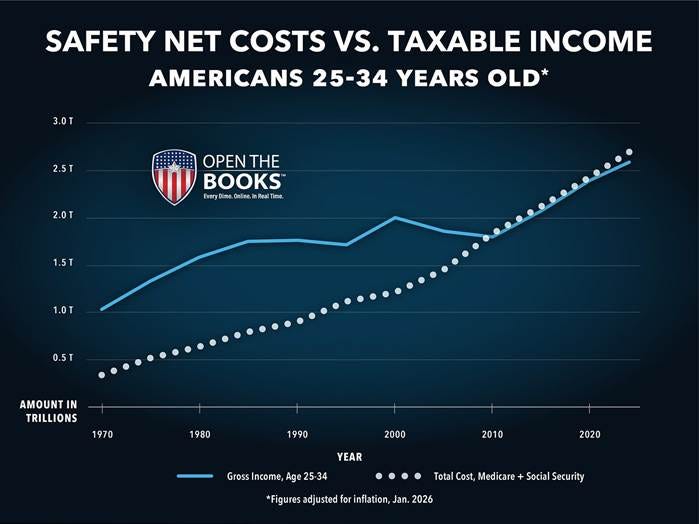
“Medicare for All” would devour much of Washington’s annual budget, but it would also start to cost as much as a whole generation can go out and earn in a year.
Second, the Department of Treasury releases a report on the fiscal status of the United States annually. As we reported earlier this year, the unfunded liabilities generated by our social safety net programs is already unfathomably large, even after accounting for tax revenue:
Today’s children, and future Americans yet to be born, would presumably use social safety net programs like Social Security and Medicare more than 100 years into the future. When they’re included, Social Security and Medicare are underfunded by $193.6 trillion over the “infinite horizon.” Again, that’s after accounting for funds that will be raised through taxes.
It’s an unfathomable amount of money that represents arguably the greatest fiscal challenge the nation has ever faced. Every federal expense in history has cost a combined $132 trillion, dating back to 1787. The net worth of every billionaire on the planet combined is currently $20.1 trillion….
In a column for Fortune, former Comptroller General David Walker and Johns Hopkins economic professor Steve Hanke put it more bluntly: “The U.S. government is insolvent.” They compared the federal balance sheet (and the off-book unfunded entitlements) to “a household budget in freefall.”
The cost of our safety net, even without “Medicare for All” included, requires massive new tax revenue to be collected before a dent could be made in the “infinite horizon” figures our country is facing. Expanding the program so drastically would create truly unfathomable numbers in red ink.
Finally, the instances of fraud seem to proliferate by the week at CMS. Prosecutors continue to charge new cases of services not delivered, care not received, fake entities like hospices and medical device companies, and more. Our Cost of Fraud series covers just some of these.
“Medicare for All” would add put every American aboard a proverbial ship we know is leaking by the billions.